Ancestors
In his spare time, a first cousin of mine set about researching our ancestors, particularly the Amelinckx branch. According to what he told me, my grandfather's grandfather was apparently a Catalan Spaniard who worked as a gardener in the service of a Spanish nobleman, who in turn held titles of nobility in both Spain and Flanders. This is not surprising, since Flanders belonged to the Spanish Crown during the era of Charles V. The title of this nobleman in Flanders was Duke of Ursel (a village near Antwerp). When this nobleman moved to Antwerp, he brought several servants with him, including the Catalan gardener, who in Flanders received the surname Amelinck, because his small house was situated on the banks of the stream called Amel, on the lands of the Duke of Ursel. The son of this Amelinck automatically took the surname Amelinckx, the "x" being a contraction of the final "k" with the genitive "s." From that point onward, the surname no longer changed. I do not know the Catalan or Spanish name of the aforementioned gardener, and I only know that, in 1947, there was still a living hedge he had planted at the castle of Ursel.
I also do not know whether he married a Flemish woman or whether he brought a Spanish wife with him. In any case, the descendants were entirely Flemish, and all other persons who appeared in the Amelinckx family tree were Flemish, with one Frenchman as the sole exception.
Regarding my mother's ancestors, no one was able to reconstruct the Van Cleemput family tree, and it is only known that they were a typically Flemish family, dedicated to farming or agricultural crafts.
My Father's Family
My paternal grandfather, Peter Amelinckx Van Puymbroeck, was a fruit grower and nurseryman. He had two sons — Cyrille and Louis — and three daughters — Urbania, Francina, and Irene. Both sons, Cyrille and Louis (or, more correctly, Benedict and Louis, my father), were teachers, as was the youngest daughter, Irene, who entered the Discalced Carmelite convent. Of the daughters, Urbania — my godmother — married a fruit and vegetable merchant, and Francina married Frans De Schrijver, an industrialist (manufacturer of knitted fabrics). There were several professionals among the children of my father's brothers and sisters: two mining engineers (Frans and León, the only children of my uncle Cyrille, whom I met both in Belgium and in Venezuela), a doctor, and a lawyer, children of my aunt Francina. Among the children of Louis (my father), I was the only university-educated professional, while my siblings Frans, Anna, and Agnes became teachers, and my brother José became a surveyor. From my aunt Urbania, married to Rafael Lavaert, there were no professional children, though one of them — Louis — became an accredited agent of the Antwerp Stock Exchange.
My father and all his brothers and sisters were fair-skinned, with black hair and dark eyes.
My Mother's Family
I never knew what profession my maternal grandfather, Camilo Van Cleemput Van Peteghm, practiced. I know only that he was strikingly handsome and affluent. He owned seven houses and rented them out. He sometimes served as the village's mayor and was a champion archer. His vigorous lifestyle steadily eroded his fortune. He also owned a brickyard employing several of his children. The enterprise failed and was abandoned, prompting his children to seek other paths. He had five sons and three daughters.
The sons, in order of age, were: León, school inspector and my godfather; Octavio, a farmer; Florimond, a school inspector; Alfonso, headmaster of a large state school; and René, a physical education teacher.
In the case of the daughters: Irma married a confectionery merchant; Maria (my mother) made corsets; and Helena was a teacher.
All these sons and daughters had descendants, with each having 1 to 9 children. Many were professionals—mostly in Germanic and Romance philology, school inspection, or mining engineering—and many became teachers. My mother and her sisters were fair-skinned, with rosy complexions, blonde or chestnut hair, and blue eyes.
My Family in Belgium
Before marrying my mother, my father wed a woman named Wuytens, with whom he had one son, Frans, and two daughters, Anna and Agnes. Widowed, he remarried years later—this time, my mother. From this union came two sons, José and Paul (myself), and a daughter, Godelieve. In truth, my father seemed to favor his first children, though he concealed it well; he was a taciturn, reserved man—precise, fair, but notably frugal.
There was also a lack of understanding between my mother and her stepdaughters, Anna and Agnes. My brother Frans, whose character resembled my father's, had no difficulties with his stepmother.
My sisters, Anna and Agnes, qualified as teachers and soon entered the Discalced Carmelite convent in Leopoldsburg, Belgium. This caused another enormous expense for my father. After funding their studies, he also had to pay the two substantial dowries required by the convent for each of them.
Frans, after qualifying as a teacher, remained single for many years, supporting my studies and my brother's. José, influenced by my two nun sisters, entered the priesthood. After two years in the seminary, he lost interest and left. He then attempted philosophy at university but failed his first-year exams. Finally, he turned to surveying, where he found success.
My sister Godelieve was not particularly strong academically, though this was due more to a lack of interest than anything else. So when she finished her secondary education, she stayed at home. Several years later, she began studying — alone, without her parents or siblings — and qualified as a social worker, which enabled her to live comfortably.
The first member of the family to pass away was naturally my father's first wife, from peritonitis at a time when that was fatal. Then it was my mother's turn, in 1946, at the age of 59, from a stroke caused by her high blood pressure. After that came my father, who died falling from a seven-metre ladder in the orchard, when he tried to prune a pear tree that had grown very tall. He broke his femur in the fall, and all his intestines — and especially his kidneys — were paralysed by the impact, which caused his death after three days of agony. The day before the accident, I had spoken rudely to my father, and the next day I found him lying in a bed in the emergency ward of the Aalst clinic, sedated with injections to relieve the pain. Even so, he seemed to understand me when I asked him to forgive me for my rudeness the day before. My father was almost 70 years old — just one week short — when he died in 1947. Louis Cappuyns was also present at the funeral.
A couple of months after my father's death, we sold the house and orchard for a strong price. With our shares—mine, Godelieve's, and José's—we bought a comfortable house for Godelieve, though it lacked an orchard, and furnished it with surplus furniture from my father's house. She had enough money to live well for years without working. Later, when José and I were in Venezuela, Godelieve's funds dwindled, and she requested more. At the time, I had little to spare, having just bought a Pontiac. Soon after, she became a social worker and excelled until a failed bunion operation made long walks impossible. She then worked in an office until retirement. In 1985, she was diagnosed with uterine cancer, and after unsuccessful surgeries, she died in 1986. In her final years, Godelieve received significant support from the daughter of an old friend. My brother Frans believed this was self-serving, as Godelieve left her apartment to the girl. It is also possible that Louise, Frans's wife, was envious, as they were not close.
My brother Frans had already married in 1943 — a couple of years before my father died — and my father only knew his first daughter, Myriam, since the two subsequent children, Paul and Luc, were born when I had already been in America for several years, and I only know them from photographs.
My sisters Anna and Agnes, cloistered nuns, naturally could not attend my father's funeral. As Agnes wrote to me, they already have their places reserved upon entering the convent. Agnes was recently sent to the first Catholic convent in Sweden, a notably Protestant country. To celebrate Mass in public, the convent needed official permission from the Swedish State, which had prohibited Catholicism until the 1950s. After a constitutional amendment, all religions were reluctantly accepted. Agnes's convent even had to hire a Lutheran lawyer for the official authorisation.
Anna, meanwhile, had remained in the convent at Leopoldsburg in Belgium, but was not in very good health, and about ten years ago they sent her to a rest convent, because the harsh discipline of the Discalced Carmelites — for example, they are not permitted heating in the convent, even if it is -20°C outside — was breaking her. She became increasingly ill, suffered several small strokes, and passed away in the rest home at Wichelen at the age of 81 in 1988.
My House in Belgium
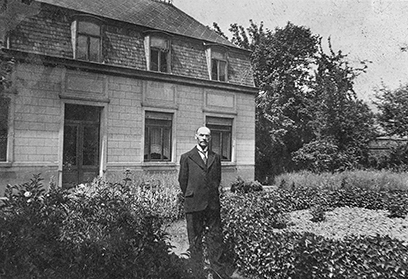
The house was located near the edge of the city of Aalst (in Flemish Aalst, in French Alost), about 1.5 km from the city centre. Originally, it had been just a bungalow, a country house with many fruit and ornamental trees, ponds for small fish, and some domestic animals: a couple of sheep, a carriage horse, a dog, chickens, and so on. The total area was one hectare, consisting of about 60% fruit orchard with natural pasture (for the sheep), 30% ornamental garden with the house in the middle, and 10% vegetable garden.
The bungalow was gradually converted into a house with 5½ bedrooms, plus amenities including a reception room, dining room, sitting room, kitchen-dining room, scullery (for washing dishes), laundry room, bathroom, toilet, water tower, and cistern. The walls were brick, the ceilings of wood and tongue-and-groove boarding, the roof of slate tiles and Eternit tiles, ceramic flooring in the kitchen and service areas, and tongue-and-groove with linoleum in the reception rooms. There was also a library on the first floor, built with lightweight construction. There was also an enormous attic where trunks and so on were stored, and where I had set up my small workshop for physics, radio, and similar activities. There was also a cellar, which, in a sense, served as a substitute for a refrigerator.
The house was located in the centre of the property, about 150 metres from the street, and therefore had no connection to the water supply or sewage system. The toilet was a small brick outbuilding over a concrete cesspit, which was emptied twice a year to fertilise the orchard. The bathtub received rainwater from an elevated tank and was heated via a small wood-fired boiler. The electrical supply was 130V single-phase. The electricity meter was placed on the earth conductor in such a way that I could use a great deal of current without the meter registering it, via a well-established earth connection. The danger, however, was that in this way one sometimes obtained 130V, other times 95V, and sometimes 170V, due to the proximity of a shoe factory where many three-phase motors were in operation.
At a safe distance from the house, there was a stable with a second level where hay was stored for the sheep. Attached to it was a henhouse with a capacity for 100 birds, all built in solid materials. In another spot, a little further away, was the horse stable — though we did not keep horses, as they would only have been for leisure riding. There was also a large walk-in greenhouse of about 60 square metres, for grapes and early vegetables. Among the fruit trees, there were pear trees (about 15 varieties), apple trees (about 10 varieties), plum trees (about 5 varieties), conventional cherry trees and sour cherry trees, strawberries of every kind, and even wild strawberries. Among the ornamental trees were pines, maples, acacias, chestnuts, and limes, among others.
Among the fruit trees, particularly notable were the pear trees of the variety "Beurré Amelinckx", which were developed by my paternal grandfather in the Antwerp region. It is an exquisite pear — in flavour, size, and aroma — and achieved third prize in the pear rankings of the time. The tree itself is also a vigorous producer.